

1. Optimize Your URL
An optimal URL structure gives context to your page, so both your readers and Google understand what you’re writing about. It helps you build a clear information hierarchy across your site.
Rule of thumb, the simpler your URL the better.
Your URL should contain your target keyword (sans stop words like a, and, the and of) and in a perfect world, little else.
In addition to providing context about the topic of your post, URLs that contain a keyword are shown to have a 45 percent higher click-through rate (CTR) than those that don’t.
So if you’re writing an article on how to build a sandcastle, your URL should follow a structure along the lines of /how-to-build-sandcastle/.
Here are some additional best practices for SEO-friendly URLs.
- Write your URL for the user. Shorter, contextual URLs are more helpful for readers and help inspire trust. Google crawls these URLs and has shown a preference for short, explanatory URLs.
- Use subfolders to avoid over-optimization. Subfolders provide context on the information hierarchy of your post. A URL subfolder of /kids/how-to-build-sandcastle/ helps Google understand that you’re a family-friendly website, without lengthening your URL slug.
- Make your URL exactly the keyword, and nothing else. Don’t add adjectives or qualifiers that could dilute your target keyword. A URL of /how-to-build-sandcastle/ will perform better than /how-to-build-sandcastle-fast/.
- Use-hyphens, instead_of_underscores. Hyphens function as a space between the words, further helping Google contextualize keywords. Without hyphens, Google would be looking at the keyword “howtobuildasandcastle,” rather than “how to build a sandcastle.”
- Remove stop-words. Filler words like “a,” “and” or “the” are unnecessary, so long as the intent of your piece is unchanged.
2. Write Your Meta Description
Meta descriptions are the blurb users see under your title tag in the SERP. Think of a meta description as an elevator pitch for your article, getting your key points across and drawing the user in less time than it takes to tie your shoe.
Although Google will sometimes generate their own meta, they recommend you write your own.
Additionally, if you don’t include a meta description, Google will create its own or sometimes even override yours with text that they feel best serves the reader.
Meta descriptions give you another opportunity to create SEO-friendly content by following best practices:
- Include your target keyword, ideally as early as possible. This passes along the strongest signal of intent to Google.
- Keep the length between 120–156 characters. Meta descriptions may be truncated, so try to convey your key points within the first 120 characters.
- Include a CTA. Invite your users to take action. Learn more, try now, find out.
- Ensure your meta accurately describes your page. Lean into your headers and post structure to convey your topic.
- Look at what’s ranking on the SERP. Are the top few posts showing their own meta, or did Google create one themselves? As a general rule, try to mirror what Google is showing.
3. Build Your Content Structure
SEO-friendly content starts with a solid foundation.
If creating a blog post is like making a sandwich, choosing your content structure is deciding between a panini, sub or hot dog (if you’d consider that a sandwich).
Your content structure is almost always inherent in your keyword.
Searching your target query in Google and seeing what formats are ranking is a good indicator of which structure you should choose.
Good post structure is written to be simple for users (and Google) to easily understand target keywords, key takeaways and unique value adds.

In general, your post structure relies on headings like H1, H2 and H3 to understand what you’re writing about. You want to build these headings around keywords — SEMrush found that 36 percent of articles using H2 and H3 tags had better traffic, share and backlink performance.While each situation is unique, an H2 can often be made of:
- Long-tail keywords
- People also ask queries
- Direct answers to your target keyword
- Information gaps
This isn’t a hard and fast rule. In fact, part of SEO-savviness is knowing when to break it. Ask yourself, “how can we not only match the SERP but outcompete it?”
In general, simpler structures are usually better. You want to answer the user query as simply and quickly as possible.
Let’s look at some examples with the keyword “how to cook rice.”
Bad Post Structure

Just like cooked rice, this post structure is fluffy (but unlike cooked rice, it’s not in a good way). Users have to skim for the actual steps, and Google has a hard time determining what’s most important.
Now, let’s look at a strong example of post structure.
Good Post Structure
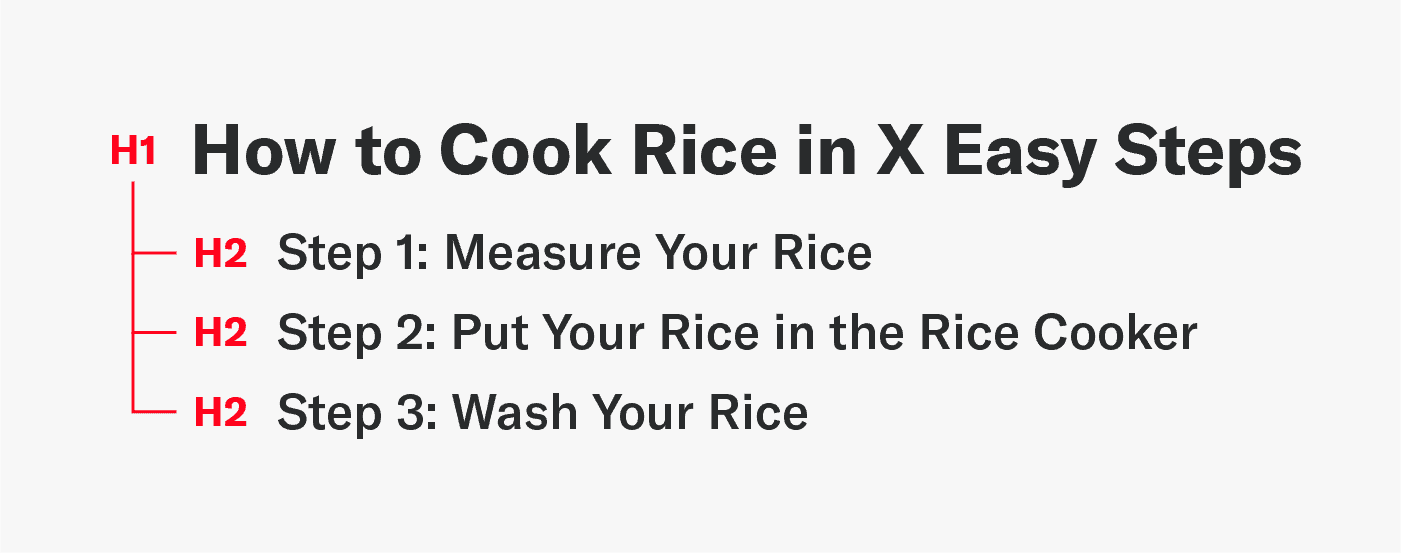
This example cuts the fat and gets to the steps immediately, meaning the reader doesn’t need to do as much heavy lifting and Google gets a clear signal of intent.
Use what’s ranking and the quick answer box as an indicator of what your post structure should look like.
4. Start Your Research and Writing
A strong post structure sets you up for success, but well-constructed, thoughtful research makes your content a home run.
Here are some of our favorite tips for more effective writing:
- Put your readers first by writing with empathy. Put yourself in their shoes to understand what they want to see and how you can convey it. How advanced is their knowledge of your topic? Do they want a brief overview or an in-depth guide?
- Keep your readers entertained. Ask yourself if you’d want to read the content that you wrote. While you don’t need to infuse a serious topic with jokes, it’s important to keep your energy up and infuse your writing with personality.
- Build trust with your readers. Make sure your claims can be backed up with proof and your writing is polished and easy to understand.
- Make sure your post adds value. Remove filler sentences, break your copy into chunks and make it easy to digest.
Learn more about our favorite writing tips in practice below.
Write With Empathy
Whether you’re managing a team, writing an article or helping your grandparents learn how to use an iPhone, empathy can be your superpower.
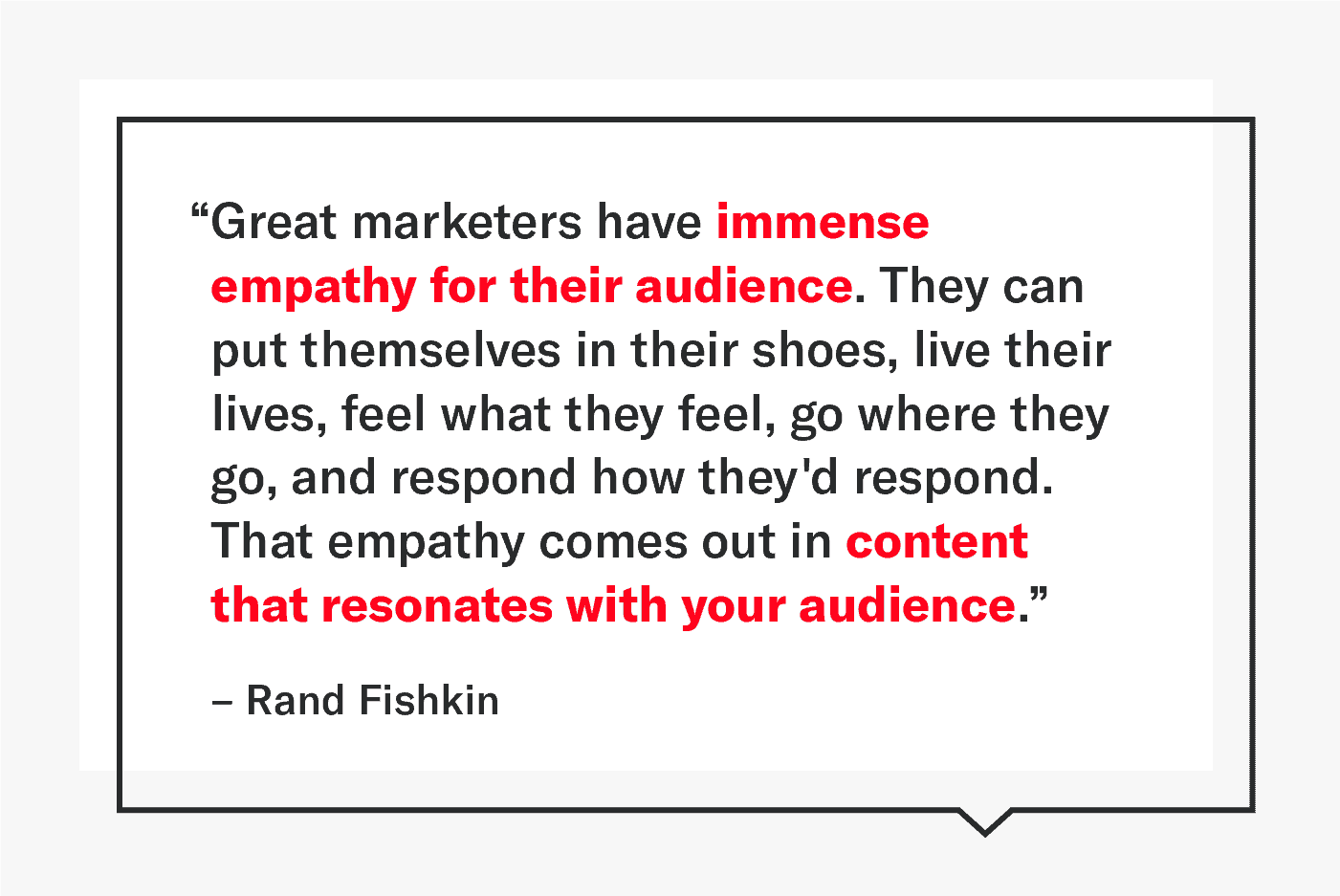
Writing with empathy helps you build organic trust by tapping into (and acknowledging) your reader’s emotions.
It means solving a problem, not just a query. By putting yourself in the shoes of the reader, you’re able to think about their needs, wants and desires. What else do they care about?
Writing with empathy means embracing intellectual humility. Regardless of how qualified you are, or what you think is the right answer, your job is to help your reader — not to help yourself.
Here are some phrases to keep empathy in mind while writing:
- Be informative, not pious
- Be helpful, not trivializing
- Be compassionate, not condescending
Showing empathy with your writing is a work in progress for the SEO industry as a whole. It requires patience and thrives on collaboration.
What’s most important is to make an active effort to be inclusionary, intentional and understanding with your words.
Keep Readers Entertained
One of our favorite ways to write engaging blog posts is with a few proven acronyms (can you tell we love these yet?). Here are some of our best tricks to make your research stand out.
Create Out-of-the-Box Content With V.I.N.E.S
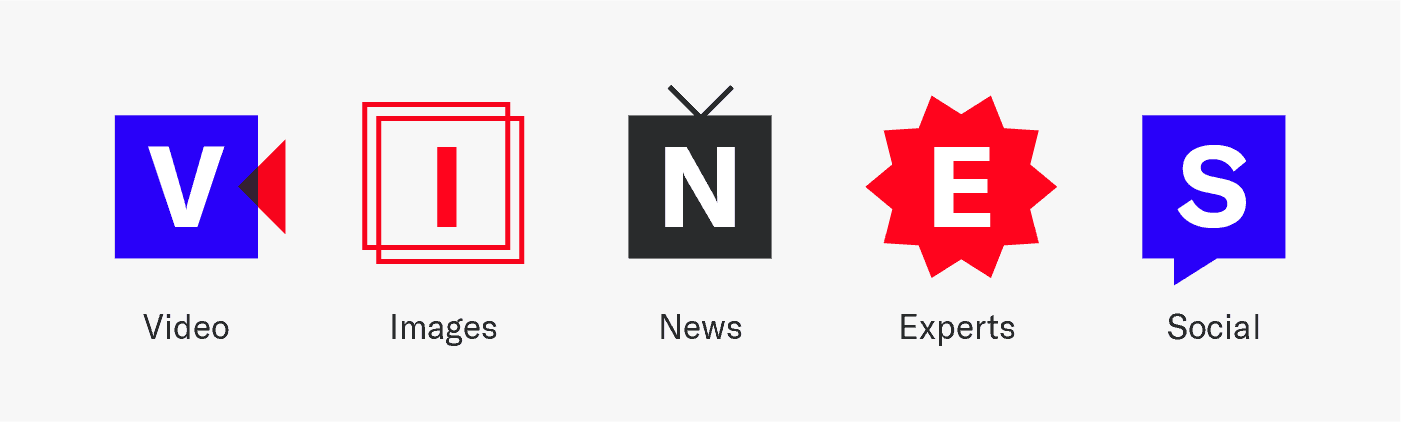
V.I.N.E.S. is an acronym for more out-of-the-box research methods. These are particularly useful for not only matching but outcompeting the SERP:
- Video: Look up your keyword on YouTube to find gaps in search intent. What are people on YouTube talking about that isn’t mentioned in articles? Can you look at the comment section to uncover new questions?
- Images: Check the “images” tab in Google. Are the images illustrative or decorative? Do they help visualize a concept?
- News: Look at the “news” tab in Google. Are there any surveys or data studies you can use? Is this a trending topic?
- Experts: Follow industry experts on social media, read industry blogs or subscribe to newsletters for thought leadership. Note that this is most valuable in B2B or business industries.
- Social: Search your keyword on Reddit, Pinterest, Etsy or Twitter to see what’s fulfilling the user’s search intent. Note that this is most valuable in B2C or lifestyle industries.
Pique Interest with P.P.B.
P.P.B. stands for Preview, Proof, Benefit. With P.P.B., you use your lead sentence as a hook to complement your headline.
We use this to reduce bounce rates and engage readers with our intro.

Your introduction should preview what’s to come, show proof of why readers should listen and clearly explain the benefit of reading your post.
P.P.B. can come in any order or it can even be combined.
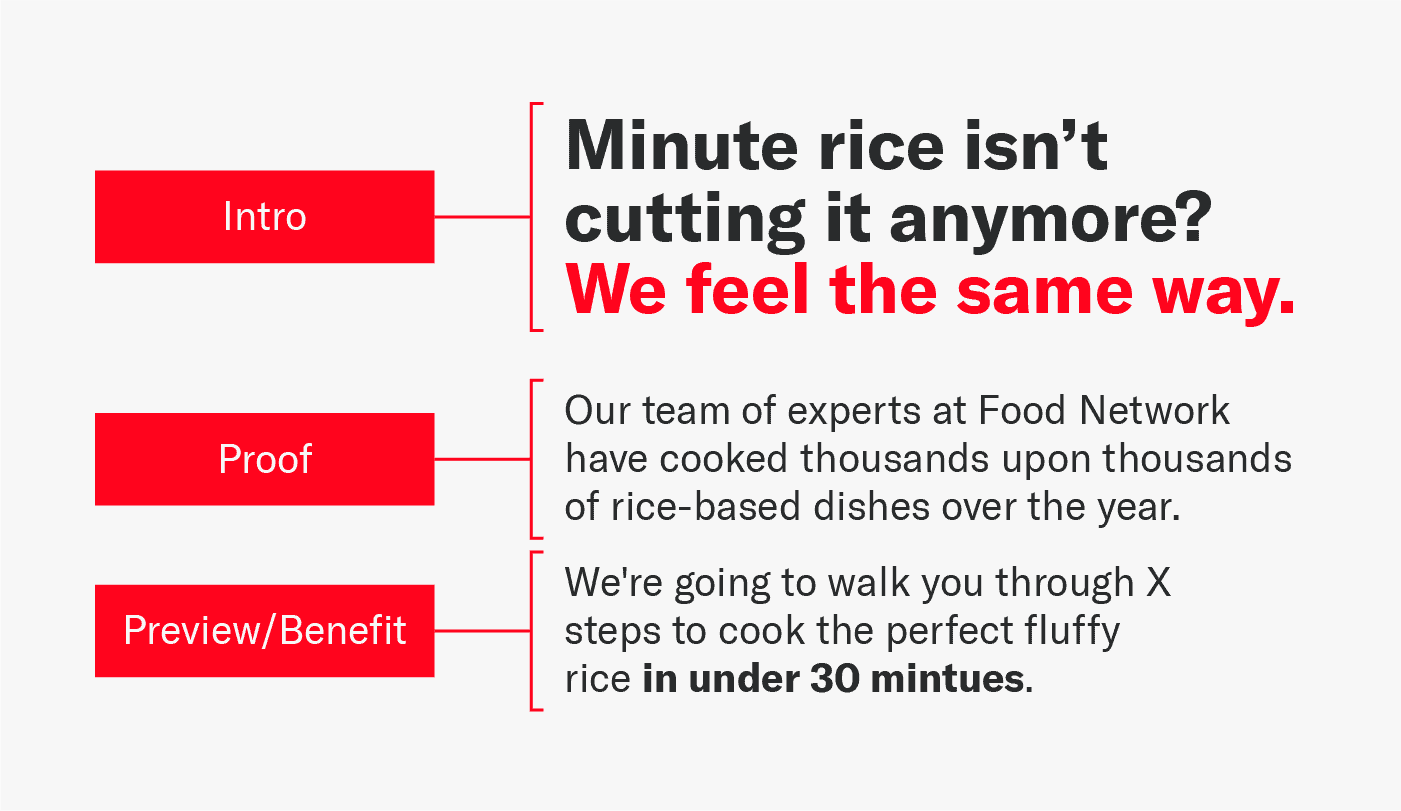
- Preview: Divulge what’s to come in the rest of the article. Tell a story to hook readers. “We’ll talk about…”
- Proof: Explain why you’re credible to talk about this. Do you have testimonials from satisfied customers, or was your post written by an industry expert?
- Benefit: Answer the query and explain how else you’ll satisfy user intent.
Build Trust with E.A.T.
Okay, we can’t take credit for this one. E.A.T. is a popular SEO term that stands for Expertise, Authoritativeness and Trustworthiness.
In addition to inspiring thoughts of tasty sandwiches, E.A.T. is an official Google ranking factor of Page Quality.
- Expertise: This refers to the blog post author. Are they knowledgeable enough to write about this topic? If not, did they do their due diligence and source facts from official sources like journal articles and industry experts?
- Authoritativeness: Similar to expertise, authority refers to the blog post author. But it also refers to the blog post content, and the website the blog is hosted on. Help a Reporter is a great resource to source original expert quotes for topics that you need to establish authoritativeness on. External linking is also a great way to establish authority.
- Trustworthiness: This means that readers can rely on your duty of care to provide accurate, honest information.
Make Your Writing Digestible
So, you finished your first draft. After celebrating, stretching and clearing the five empty coffee cups on your desk, it’s time to start editing.
You’ve likely looked back on your work before and seen the dreaded wall of text. It could be the most beautiful, eloquent writing in the world — but you know that it needs to be broken up, or readers will skip past it.
There’s no beating around the bush: bad user experience equals bad SEO.
That’s why scannability is so important. SEO-friendly content doesn’t make readers do the heavy lifting. It has clear hierarchical features to emphasize the key takeaways. Here are some tricks to make your content more digestible:
- Use bullets and numbered lists to make copy more digestible. Let’s be real: there’s a solid chance you skimmed the intro above and jumped straight to this bullet. It’s ok — we all do it. Caltech neuroscience ran a study to figure out why: users think less about preference and more about what sticks out.
- Add crawlable tables to contextualize your information. Let’s look at the SERP for “womens sizes.” Google understands that you want a quick answer, so it pulled up a crawlable table to faster solve your query.

- Compare your article length to competitors. Ideally, you want to match or slightly exceed what’s ranking on the SERP.
- Compare your lists to competitors. While you want to slightly exceed the competition here as well, it’s worth noting that quality trumps quantity, especially in more business-leaning industries. Users might not need a list of 300 of the best project management tools, which could ultimately lead to a higher bounce rate.
- Make your sections (roughly) equal. Users can be thrown off if you write an essay about step #1 and only have two sentences about step #2.
- Keep your paragraphs 5–6 lines max. Longer paragraphs lead to skimming the article. Give your readers a visual break by keeping paragraphs short and concise. As a general rule, one idea equals one paragraph.
- Add a table of contents. A table of contents provides a clear preview of your article and can improve crawlability.
- Add in-post text boxes. These create a visual callout for the reader while still allowing Google to crawl the copy.
- Introduce complimentary text colors. Adding subtle, branded color to your subheads helps drive home your branding and creates visual callouts for the reader.
Well-architected posts put scannability and post structure at the forefront.
5. Build Your Internal Linking Web
Internal links make your post findable and create a natural information hierarchy. Google has also confirmed that internal links count as a ranking factor.
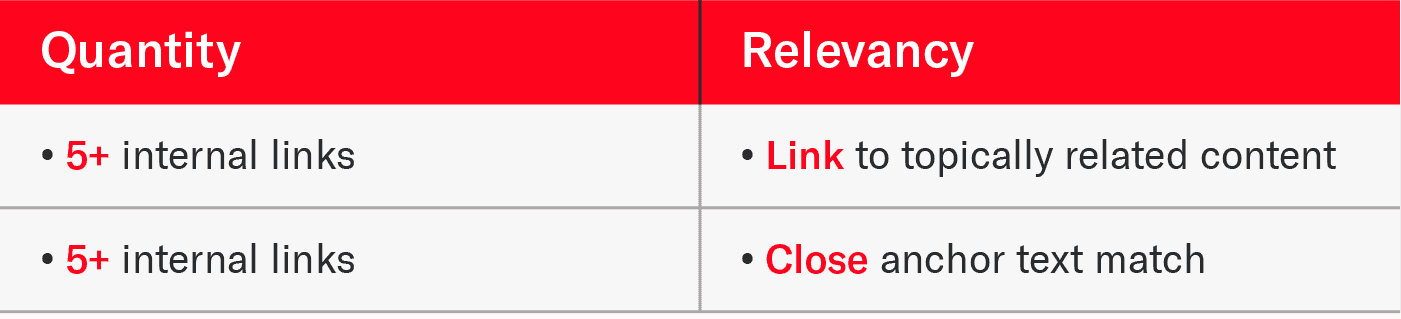
Here are the main principles of building a well-optimized internal linking strategy.
Quantity
In general, you should be aiming for at least five internal links and five outlinks on each piece of content.
This prevents orphan pages or pages that don’t link to anything else on your website. Orphan pages are difficult for Google to contextualize and therefore can have a hard time ranking for their target keyword.
As you’re writing your post, find five relevant pages on your site and add your new post’s link within the live posts.
Then, find five relevant blog posts on your site and add links to the live posts within your new post.
As an added bonus, internal linking makes users more likely to stay on your site, since they’ll be clicking through to related blog posts.
Relevancy
The pages you link to matter. Google crawls your site through these internal links, so you need to make sure your links are topically related.
Let’s revisit our sandcastle example from earlier. If you’re writing about how to build a sandcastle, you’ll want to link to posts around similar topics, such as:
- What to do at the beach
- What to bring to the beach
- Summertime kids activities
All of these topics are tangentially related to your post and will help Google contextualize the topic of your article.
Additionally, you want the actual anchor text used to be topically relevant. Good anchor text helps Google contextualize the page you’re linking out to.
Say your sandcastle blog post talks about different tools you can use to level up your castle: shovels, buckets or even a paint scraper. This would be a natural location for you to link to a post on what to bring to the beach.

Your internal links should be spread out throughout your post. Too many links in one place leads to a bad user experience, and a bad user experience equals bad SEO.
0 Comments